Before I get into my hypotheses about why NZ students, on average, perform better on the PISA assessments, and before I begin to explain my thoughts on effective digital pedagogies, I need to describe the NZ school system from a perspective within the schools in order to build a context.
School Age
All eligible students may enter school at the age of five. Compulsory schooling begins at age six, though. Parents have between the time their child turns five until the child turns six to enroll in a school. Some parents wait until the start of the next school year following the child’s fifth birthday, but many just enroll the child when he/she turns five. Unlike Illinois, there are not any rules or birthday cutoffs to determine which year/which grade level students are enrolled in. This means if a student turns five in the middle of the school year, the child can begin schooling in the middle of the school year. I’ll explain why this isn’t a logistical and curriculum problem in a future post when I talk about the New Zealand curriculum. When students enter school at the age of five, they start in Year 0.
When a child turns age three, he/she is eligible for government-funded pre schooling. The government doesn’t provide 100% of the funding, though. Instead, the program provides 20 hours per week of preschool funding (at an hourly rate set by the government). While there is controversy surrounding this policy, the goal of the program is to provide all students, regardless of their family income, at least 20 hours of early childhood education (ECE) each week. The controversy of the 20 ECE program comes from the nature of private preschool providers. Some providers have higher costs than what the government provides in funding and therefore charge parents for the additional costs (Powley, 2013). These higher cost ECE providers are usually found in high SES areas where families typically want their ECE programs to offer more than just the minimum expectations (e.g. in-house cook with vegetarian meals, specialty music teachers, etc.). In low SES areas, though, many ECE programs provide the minimum expectations which keeps costs balanced with government funding allowing low SES children to participate in early childhood education and low SES parents to work while the child is in school. The government has another program for low-income families to help pay for above 20 hours ECE (Bushouse, 2008; Ministry of Education 20 hours ECE, 2016). There is also debate about the effects of the ECE program, but the government does not have measures in place to determine if the program is better preparing students for formal schooling. Additionally, there are concerns that some ECE providers do not have qualified teachers with students (Johnston, 2016).
In the first paragraph I specified that “eligible students” have access to public schooling. A child is “eligible” if he/she is a citizen of New Zealand or has a resident visa. Enrollment in public schools requires proof of citizenship or copies of the resident visa. Children without these credentials do not get publicly-funded educations. The ECE program, however, is available to all children, regardless of immigration status.
School Year
The NZ school year begins in late January/early February and ends mid-December. The school year is composed of four terms, each being 9-11 weeks long. Between school terms is a two week break. The summer break is about six weeks long from mid-December through the end of January. Also, the school terms are organized nationally by the Ministry of Education (Ministry of Education School terms, 2016). All primary and secondary schools follow the same calendar which means that all students in NZ are off of school at the same time. It also means that all teachers are off of school at the same time. The breaks between school terms allows families to travel and spend time together throughout the academic year. It also minimizes the length of the summer break although “summer slide” is a concern here too. Two of the principal investigators from the research center I work in published a paper regarding summer slide in New Zealand and interventions they attempted to to reduce the academic loss during the six weeks (McNaughton, Jesson, Kolose & Kercher, 2012). The quantitative data from my research projects also show there is significant summer slide in reading, writing, and math. In the area of technology, a colleague of mine is researching and working on a blogging intervention to reduce summer slide in the area of writing (Williams, 2016).
Timetables (Daily schedule)
This is where the primary schools differ from the secondary schools. In all schools, the school leadership team decides (with approval by the Board of Trustees) the daily schedule.
Primary schools usually start school around 9:00am with a lunch break around 12:30pm. Between school starting and lunch is Morning Tea break. Morning Tea usually happens around 11:00 and lasts about 20 minutes. This is a time for students to take a mental break, have a snack, run around outside, or chat with friends. It is also a time in which all staff, except those assigned on the rotating supervision schedule, gather in the staff room for tea, coffee, water, and snacks and talk. Lunch break lasts up to an hour. Children can choose from a variety of activities during lunch break: visit the library, play on the playground, run around school grounds, and even go swimming during terms 1 & 4. School usually ends around 3:00pm. This image is the timetable from one primary school. As you can see, there is a lot of time dedicated to free play and choice. Also, this school adds in an additional snack time for Year 0 & 1 students called, “brain food snack”. This school is very clear that brain food snacks should only be vegetables or fruits.
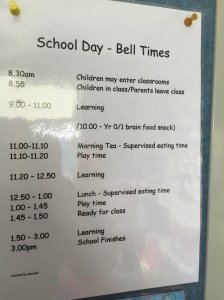
Secondary schools have timetables that vary considerably between schools. Some schools have timetables that look similar to traditional U.S. high school schedules which is about 50 minutes per class. Many schools in New Zealand include a “homeroom” at the start of the day. During homeroom, teachers have curriculum they teach a small group. The homeroom curriculum usually involves behavior expectations, career counseling, community involvement, etc.
Some secondary schools have dramatically changed their timetables to reflect their instructional goals. I’ll report on these schools in a future post because they have many innovative ideas which deserve their own blog post.
Transitions
New Zealand schools have a variety of structures. Most schools identified as primary schools serve students from Years 0-8. However, a few primary schools only serve students to Year 6 and then move students to an intermediate school for Years 7 & 8. Students attend secondary school from Years 9-13. Secondary school is referred to as “high school” and “college”. “College” in the American sense is referred to as “Uni” or “university.” There is significant academic and behavioral adjustment that takes place between the transition from primary school (Year 8) to secondary school (Year 9). One of my research projects is investigating the pedagogy in the area of Reading between Years 7-10 to better understand the complex instructional changes students face when transitioning from primary (or intermediate) school to secondary school.
References
Ministry of Education. (2016). 20 Hours ECE.
Ministry of Education (2016). School terms and holidays.
Powley, K. (2013). Kiwi families conned by promise of ‘free’ childcare. New Zealand Herald.
Williams, R. (2016). Summer Learning Journey 2015/16. Manaiakalani Education Trust.
 Robert E. Lang, Ed.D.