Let’s just get the exciting and powerful information out here at the start. The entire New Zealand education curriculum is standards-based and students very rarely earn “grades” for courses.
Now that I’ve described the technicals of schooling in New Zealand, I want to explain the curriculum. It is very different than the curricula found in the U.S.. First, remember that New Zealand has a national education system. Because of the size of New Zealand, there aren’t individual states that have their own rights, policies, and curriculum related to education. The curriculum comes from the Ministry of Education and schools are strongly encouraged to follow it. With that being said, though, the curriculum is not a set of learning standards (like Common Core and parts of Next Generation Science Standards). The curriculum documents specifically state that the curriculum’s “principal function is to set the direction for student learning and to provide guidance for schools as they design and review their curriculum”.
The Curriculum
The New Zealand national curriculum contains more than just knowledge and skills for students. It contains the principles for the curriculum, values, key competencies, official languages, learning areas, effective pedagogy, and the process for schools to follow when creating and adapting their own curriculum. The vision for the New Zealand national curriculum is to assist students in becoming confident, connected, actively involved, and lifelong learners.
Principles – when schools design and revise their curriculum, it should contain these eight elements.
- High expectations for all students
- Explains and places high value on the Treaty of Waitangi
- Celebrates cultural diversity
- Inclusive of all learners
- Teaches students to “learn how to learn”
- Has coherence between subject areas and year level transitions
- Focuses on preparing students for the future
Values – through school curricula, students should be encouraged to value
- Excellence/Perseverance
- Innovation, inquiry, and curiosity
- Diversity
- Equity
- Community and participation
- Ecological sustainability
- Integrity
- Respect
Key Competencies – students should be encouraged to develop these key competencies within social contexts and across all year levels.
- Thinking: creative, critical, and metacognitive processes to make sense of information, experiences, and ideas
- Using language, symbols, and texts: working with and making meaning of the codes in which knowledge is expressed
- Managing self
- Relating to others
- Participating and contributing
Official Languages – New Zealand has 3 official languages: New Zealand English, Te Reo Maori, and New Zealand Sign Language. Students are encouraged to learn all three languages during their schooling years.
Learning Areas – the New Zealand national curriculum establishes the major learning areas that schools should design curriculum around.
- English
- The Arts
- Health and Physical Education
- Learning Languages
- Mathematics and Statistics
- Science
- Social Sciences
- Technology
Effective Pedagogy – The New Zealand national curriculum combines what we (Americans) usually think of as curriculum along with teaching standards. The NZ curriculum states that effective pedagogy contains these elements.
- Creating a supportive learning environment
- Encouraging reflective thought and action
- Enhancing the relevance of new learning
- Facilitating shared learning
- Making connections to prior learning and experience
- Providing sufficient opportunities to learn
- Teaching as Inquiry
If you take some time to read through the New Zealand national curriculum document you’ll see that there are a lot of visionary statements that are found in most attempts at creating large scale curricula. There are a few themes, though, that I want to highlight.
First, there are many links throughout the curriculum document that highlight the importance the New Zealand society places on celebrating diversity. I see this celebration of diversity in the classrooms I visit. There are research projects continuously happening in which students are discovering new ideas about different cultures. There are weeks throughout the academic year that celebrate and teach different languages. There are cultural presentations made during school assemblies. There are even cultural events in the local parks in which authentic song, dance, and food is prepared for everyone to experience. Now that I’ve participated in classes where all cultures are celebrated and have witnessed the pride on students’ faces when their culture is highlighted, I have gained an enormous appreciation of how important it is to truly celebrate diversity within schools, classrooms, and communities.
Second, the curriculum also has many links to individualize learning for all students. I’ll talk more about this idea later in this post. The main point here is that the focus is on the development of each individual student.
Third, I want to highlight Key Competency 3: Managing self. This key competency is embedded in the culture of teaching here in New Zealand. During my observations, I frequently see teachers spending time with students talking about self management and offering feedback, both positive and constructive, when students demonstrate effective self management. One key area of this is through technology use. Because the culture of teaching here highlights the importance of teaching students to self manage, here’s the number of times that I’ve heard teachers talk about wanting to remove technology from classrooms because of distractions: ZERO. The only time I’ve heard concerns about technology causing distractions is from parents trying to figure out how to bring digital/non digital balance back to their households. In general, teachers here see mobile devices as a duty and opportunity to teach students to self manage their behavior with technology. I believe this is because the culture of teaching contains the element of teaching self management.
Curriculum Achievement Objectives
After the national curriculum was launched, schools were concerned because the curriculum didn’t provide them with enough of a guide for creating and providing an adequate curriculum. Remember that schools are now isolated because of the reforms started in 1989. So, most schools are looking for clear guidance from the Ministry of Education for things like curriculum. In response to this concern, the Ministry created the curriculum achievement objectives, which are very similar to what are called standards in the U.S..
The curriculum achievement objectives state specific learning objectives that students should master at each level. This is a very important point. The learning objectives are separated by mastery level, not year level in school. The learning standards in the U.S. are separated by year level in school because the U.S. typically breaks schooling into specific academic years. The New Zealand system doesn’t set such rigid boundaries to learning. Instead, students are on a continuous spectrum of learning from Year 0 through Year 13 (K-12). The rate at which each student progresses through the learning objectives is completely individualized for every student. The goal is to have each student master the entire curriculum by the time they leave Year 13. Take a look at this suggested progression of curriculum mastery from the Ministry of Education.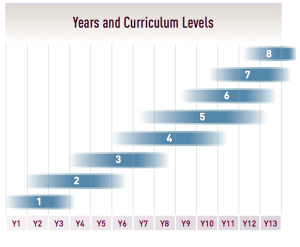
A student should master level 1 of the curriculum objectives by the end of Year 3. Going a little further shows that a student should master level 4 of the curriculum objectives by the end of Year 10, maybe beginning of Year 11, depending on the student. It also shows that a student in Year 3 could also be working on level 2 of the curriculum. Take some time to think about how incredibly powerful this version of curriculum is. If a student is not mastering level 2 by the end of Year 4, no worries. That student still has some time in Year 5 ,and in some cases part of Year 6 to master level 2. With this version of curriculum, learning does not artificially stop at the end of an academic year. Instead, at the start of the next academic year, the teacher continues with the learning level the student achieved in the previous academic year. By the way, there is only 6 weeks between academic years, unlike the 10-12 weeks usually found in the U.S.. Also, it is very common for classes to be stacked in primary (Year 0 – Year 8) schools. When I do observations, I frequently participate in classes labeled as “Year 3/4” or “Year 5/6” or “Year 7/8”. In some of the rural classes I’ve been in, the class is a “Years 4 – 8” classroom. It doesn’t matter that students of different grade levels are in the same classroom because instruction is so individualized. This version of curriculum also allows advanced students to continue through the curriculum levels without arbitrary restrictions like waiting for the next academic year when the topic is usually taught.
So what happens if a student does not master the curriculum by the suggested times from this chart? Special Education case studies then kick in. The student is evaluated to determine which additional academic supports he/she needs in order to progress through the curriculum levels. The New Zealand curriculum is coherent and aligned from Year 0 through Year 13 even though schools are isolated from each other.
NCEA
The National Certificate of Educational Achievement (NCEA) is an additional layer of standards-based academic achievement in place in high schools. The best way to describe this system is a hybrid between course credits typically earned in U.S. high schools and the assessment processes found in the Advanced Placement (AP) courses in the U.S.. New Zealand previously had a system in place that was very similar to the U.S. high school diploma. A student passed enough courses and was awarded a diploma and sent on their way. New Zealand wasn’t happy with this system. So, they blended their schooling system with their professional and trades credentialing system, New Zealand Qualifications Authority (NZQA).
NZQA is the national authority that provides credentials for people to work in specific jobs. Trades and professional positions have qualifications evaluated through NZQA to get clearance to work in those fields. It is a very nationalized system to ensure that all people are trained properly and have acquired the proper training/learning to be effective and safe in their jobs.
Under NCEA, students choose courses to take during Years 11, 12 and 13 of high school. The courses are offered by schools and are strongly aligned with specific learning targets. Schools are free to modify the curriculum, but the alignment happens through student assessment. Students can earn an NCEA certificate at three different levels. Level 1 is the highest and Level 3 is the lowest. Within each course, there are specific Unit standards (competency based) and Achievement standards (based off the New Zealand national curriculum) that students must master. Students are assessed both internally by the teacher and externally by representatives from NCEA to determine which standards they have mastered. Internal assessments occur throughout the academic year while external assessments are typically at the end of the year. Students typically have multiple opportunities to demonstrate mastery of standards with the internally-assessed standards. External assessments are usually in the form of exams, but sometimes use portfolios as the assessment evidence. Students do not get opportunities to re-assess on external assessments other than the next academic year. Students aim to earn credits throughout their high school years. However, these are NOT course credits. These are standards credits. This means that students can perform very poorly on some standards within a course while excelling at other standards within the same course… and that is OK!
NCEA is a very complex system that many parents are still confused about even though the system has been in place for over 10 years. The important thing to know, though, is that the high school experience is entirely standards-based and that students are not awarded credits for courses. Instead, they are awarded credits for mastery of learning standards. There are no report cards with ‘A’, ‘B’, ‘C’, ‘D’, or ‘F’ on them. There is no debate about the fairness of an ‘F’ representing 59 points on a 100-point scale. There is no Grade Point Average (GPA) for students to obsess over. There are no debates about how much of a semester grade should be weighted based on assignments, quizzes, or homework. There are no semester exams!
Progress Reporting
So if students don’t receive report cards with letter grades, how are they and parents informed of their progress? Well, its very similar to a standards-based report card. Students and parents are given progress reports periodically to let them know which level of the curriculum the student is at in each subject area. The progress reports also state the skills needed in order to move to the next level of the curriculum. Here is another important point: These progress reports are not sent out at the same time for each student. There are no arbitrary ends of learning (like end of academic year). Instead, reports are issued based on the date the student entered the school. For example, if a student enters school on her 5th birthday, all progress reports will be scheduled based off that first date the student attended school. These reporting dates are spaced every 20 weeks. So, regardless of when the student started school, 20 weeks after the first attendance day, the parents get a progress report. Repeat at 40 weeks, 60 weeks, etc.
So, what determines which level of the curriculum a student is achieving at? Well, New Zealand uses a system called OTJ to determine which levels of the curriculum students have mastered. OTJ combines multiple data points such as assessments, student presentations, artifacts of learning, and observations. So what exactly is OTJ? “Overall Teacher Judgement”. Yes, that’s right. Teachers are professionalized to the level that their judgement is the only tool used to determine student achievement. Which gets me to my next point… national testing.
National Testing
I know what some of you are thinking… So, if there aren’t any grades issued and teacher judgement is used to determine student achievement, what national assessments are used to determine that students are learning? NONE! National testing is not a thing here because they use different mechanisms to ensure equity across schools. In fact, here national testing is viewed as a mechanism of distrusting schools to do their jobs.
Overall Teacher Judement (OTJ) does have some difficulties, though. The largest issue to equity. How does the system ensure that the definition of level 3 of the curriculum is the same throughout the country? Teachers are periodically required to go through “moderation” which is their phrase for inter-rater reliability. These are periodic checks to ensure that teachers are similar in their assessment.
Also, just because national, standardized tests don’t exist here doesn’t mean that schools are not monitored. The Ministry of Education uses other mechanisms to monitor schools. As I stated in a previous post, schools are visited, on average, every 3 years by the Education Review Office (ERO). During these visits, a small group visits classes, inspects curriculum document, financial documents, and community engagement documents. The group also analyses the OTJ data to determine how well students are progressing through the curriculum. Reports are generated and feedback is made public for all to see. In extreme cases, the Ministry has take control of schools that have not improved in years. But that is very rare.
I’m now into my 9th month of living in New Zealand and I’m still making sense of the entire education system including the national curriculum and NCEA. I’m very fortunate to be working in an education research center where we use these data in our research. I frequently get to participate in and listen in on conversations about the curriculum. These experiences have helped me tremendously to better understand this system of education where the focus is not on competition between students, but instead on the growth of each individual student.
Links for more information
New Zealand National Curriculum
New Zealand Qualifications Authority
National Certificate of Educational Achievement
 Robert E. Lang, Ed.D.