Disclaimer: Education is more than just performance on standardized tests. Education, of course, includes student achievement, but it also has components that are not so easy to measure. This includes teaching students empathy, verbal communication skills, healthy habits, self-regulation, and many other aspects of being good people and good to others. But, those teachings and skills are culture-specific and are nearly impossible to compare across nations. This post is limited to just one part of schooling: student achievement.
To start out my journey of comparing the New Zealand education system to the U.S. education system, I first looked into one of the few measures available to compare students across the globe: the PISA assessment. (https://www.oecd.org/pisa/) PISA stands for the Programme for International Student Assessment. PISA is an assessment given to 15-year old students within the OECD (Organization for Economic Cooperation and Development) group and a few additional countries every 3 years. PISA has focused on different areas of learning since its inception in 2000, but has consistently included reading and math on each assessment. I looked specifically at Reading and Mathematics. I plan to look at Science soon. In various PISA reports, Reading and Math have been broken down further into specific skills. For my purposes, though, I’ll focus just on the average (mean) scores. Using these average scores and the longitudinal data from the PISA website, rankings between countries and trends in student achievement can be seen. Here’s what the math scores look like for a few countries since 2000. Keep in mind that these are just a few of the many countries found in the reports.
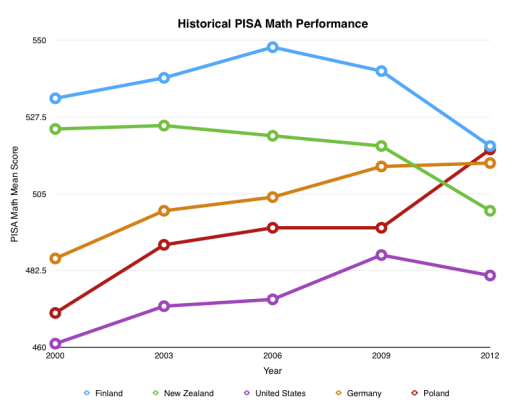
I included Finland because people tend to think of them as the “ones who solved education’s problems.” However, looking at my graph above, you can see that Finland has historically been the highest performing, but they are declining quickly. Sorry Finland, but it appears that your party is over. PISA 2015 results should be out soon. We’ll see how Finland is doing at that time. I added New Zealand on the chart because it too has historically been a high achieving country and I’m currently embedded in the local schools in New Zealand. However, New Zealand appears to be in the same situation as Finland. The U.S. is the purple line for reference. Good news for the U.S. is that the math trend line is heading up!
Here are the average reading scores. There was a testing error in 2006 for the U.S. so no scores are available for the U.S. in 2006.

The story appears to be the same for reading. Two high achieving countries are seeing their scores drop, but this time the U.S. is remaining relatively flat.
I should also note that I added Poland mostly because of the work that Amanda Ripley did in her book, Smartest Kids in the World. In that book, Ripley found that Poland implemented some major changes in its educational system since 2000 and attributes most of its gains to those changes. Side note: one of my criticisms of Ripley’s book is that it is written from a general public lens which is great for selling many books and informing the general public, but it doesn’t give school leaders much to work with in terms of improving teaching and learning within their own school buildings.
I added Germany in my charts because their data showed large improvements, but the reporting on the educational system changes within Germany have been relatively quiet. I’ve already hinted to my wife that I’d like to go to Germany for a bit to see what they’re up to… negotiations continue :-).
Summary
New Zealand has historically been a high performing educational system as measured by PISA reading and math. While, on average, New Zealand students still outperform U.S. students, their scores are trending downwards. I’m very fortunate to be in a situation where I have access to world-renowned scholars in literacy and mathematics and I also frequently visit schools to observe teachers and talk with school principals. As I continue with my professional readings, classroom observations, and discussions with scholars and principals, I hope to discover reasons why New Zealand students, on average, perform better than U.S. students and also which factors are impacting the downward trend in the New Zealand student scores. I’m hoping to find specific ideas that U.S. school leaders can benefit from and also to identify ideas to avoid in order to prevent downward trending data.
 Robert E. Lang, Ed.D.
Where do the students with IEP’s (Individual Education Plan) fit in with the data? Were students who are on the spectrum, have severe learning disabilities, attention-deficient hyperactivity disorder, English Learner students, students who have visual or hearing challenges, students who are homeless, and students who receive assistance from school districts with free or reduced charges for breakfasts and lunches included in the PISA?
What was the educational level of the parents who completed the surveys?
LikeLike
All great questions, Pam! A major question I have is who chooses which students take the PISA? I should be able to find this out in a few weeks. I will note, though, that most Special Ed and ELL (they have a different name for it here) are fully inclusive. Also, “free and reduced lunch” is minor compared to the governmental assistance poverty students receive here. I’ll be sure to include a post about all of this at some point.
Thanks,
Rob
LikeLike